
Why Is a Manufacturability Check Necessary Before SMT Assembly?
2026-07-31
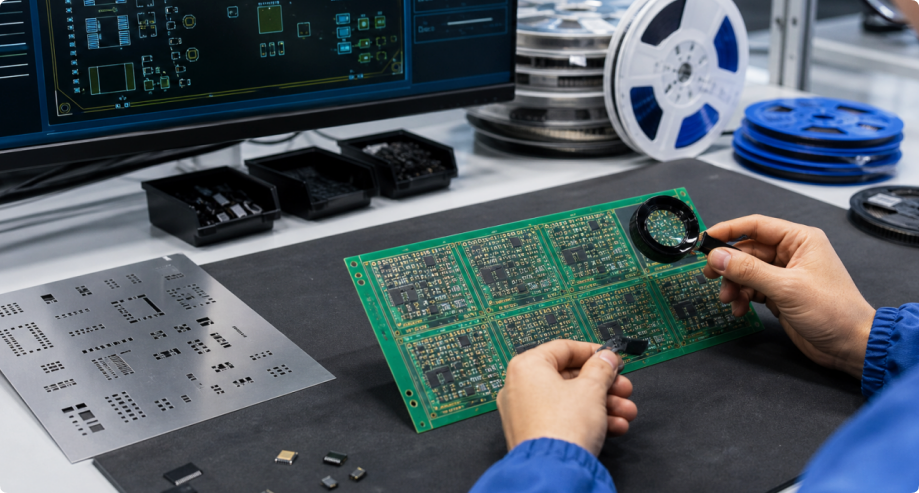
Many PCBA projects focus on placement speed and equipment configuration while overlooking pre-production engineering review. In reality, component packaging, pad design, stencil apertures, panelization, and BOM data jointly affect printing, placement, reflow soldering, and inspection. IPC's manufacturability guidelines also identify design review as a critical step before products enter manufacturing.
First, verify that the package matches the physical component.
The same device type may come in different packages, pin pitches, and thermal pad structures. If the ordering part number in the BOM, the coordinate file, and the PCB footprint are not aligned, components may fail to mount, be oriented incorrectly, or have mismatched pads. The engineering review should cross-check device datasheets with actual packaging information — not rely solely on generic package names.
Second, check the matching relationship between pads and stencil.
More solder paste is not always better. When dealing with fine-pitch devices, bottom-terminated components, and mixed component sizes, stencil thickness and local aperture design must be adjusted based on pad dimensions, solder paste characteristics, and equipment capabilities. IPC publications indicate that PCB layout affects stencil thickness and aperture design — design review and stencil engineering should be coordinated.
Third, verify panelization, board edges, and component spacing.
Panelization affects not only material utilization but also printing support, placement machine conveyance, depanelization stress, and inspection access. If connectors, edge components, or tall components are placed too close to depanelization lines, mechanical interference or stress risks may arise during subsequent assembly. Process edges, fiducial marks, and depanelization methods should be determined based on board outline, equipment, and batch size — not by applying a single fixed value.
Fourth, resolve documentation issues before production starts.
Complete production documentation typically includes PCB fabrication files, BOM, placement coordinates, assembly drawings, polarity instructions, special process requirements, and revision information. If there are conflicts in reference designators, revisions, or orientations between documents, the production line will have to stop for repeated clarification. The value of a manufacturability check is to resolve all these issues centrally before material preparation and production begin.
For pilot runs, pre-production engineering review does not guarantee that all tests will pass on the first attempt, but it can significantly reduce obvious design and documentation issues. STG Electronic can conduct board fabrication and assembly reviews based on actual board design, components, and equipment conditions — and then finalize stencil, panelization, inspection, and production plans accordingly.
Board Debugging Unstable? The root cause is mostly hidden in the PCB power and PCBA design.
Why Do Industrial Devices Get More Expensive – and Why PCB Matters More Than Chips?


SEND MESSAGE