
Can Your PCBA Survive -40°C?
2026-10-14
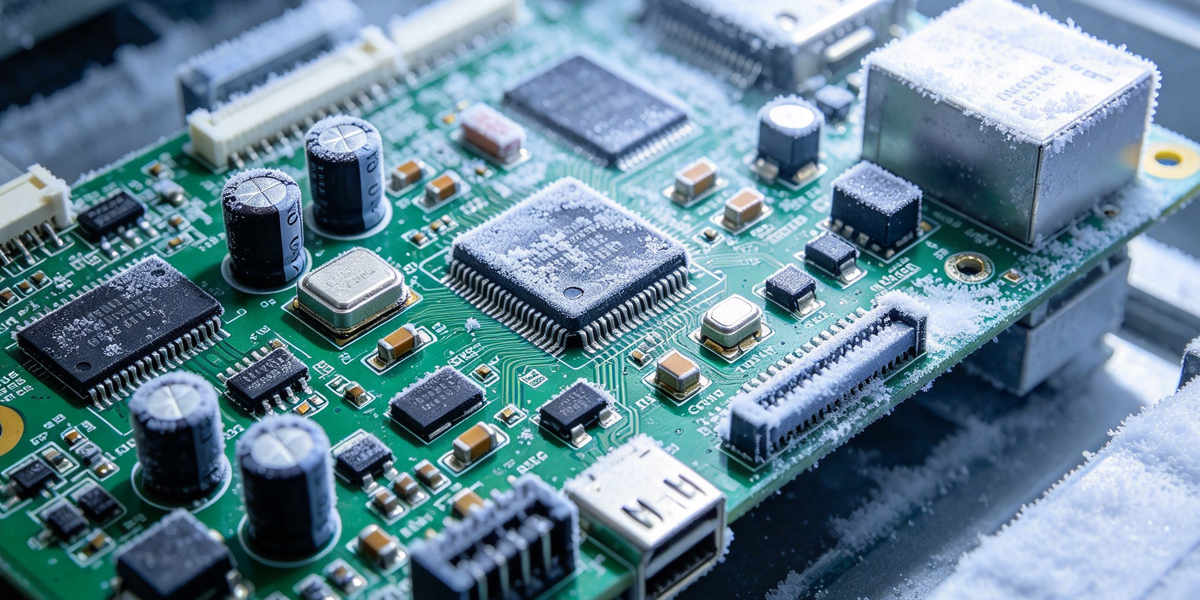
Last winter, a client who makes outdoor equipment came to me. His PCBA boards passed every test in Shenzhen. Then he shipped them to a customer in Canada — and at minus thirty-something, they wouldn't start.
He sent them back. I opened one up. The electrolyte in the electrolytic capacitors had frozen.
What Happens at Low Temperatures?
Not every component fears the cold. But the ones that do tend to cause serious trouble.
Electrolytic capacitors are the classic example. At room temperature, capacitance is normal. At minus tens of degrees, the electrolyte thickens or freezes outright. ESR spikes. Capacitance drops. Ripple voltage goes up — and the system resets or refuses to start.
Crystals and oscillators are also affected. Frequency drifts with temperature. Communication fails. Bluetooth drops. Wi-Fi disconnects. The customer thinks it's a software bug. It's actually the hardware drifting in the cold.
Solder joints are trickier. Different materials expand and contract at different rates. After a few cycles between room temperature and freezing, stress builds up inside the joint and it starts to crack. This kind of failure is intermittent — fails when cold, works when warm. The hardest kind to diagnose.
Plastic housings and connectors become brittle in the cold. A little force, and they crack.
None of these problems show up at room temperature.
How Do You Know If Your Board Can Take It?
Check the operating temperature range of your components.
Grade Temperature Range Typical Use
Commercial 0°C to 70°C Indoor consumer electronics
Industrial -40°C to 85°C Outdoor, industrial control
Automotive -40°C to 125°C Automotive, harsh environments
Commercial 0°C to 70°C Indoor consumer electronics
Industrial -40°C to 85°C Outdoor, industrial control
Automotive -40°C to 125°C Automotive, harsh environments
If your product ships to cold regions, choose industrial-grade components at minimum. Swap electrolytic capacitors for solid-state or tantalum. Use wide-temperature crystals. Leave stress margin in your solder joint design.
Low-temperature performance isn't something you can just "roughly" handle. Passing tests in Shenzhen doesn't mean it'll work in Winnipeg.
If you're not sure whether your BOM can handle the cold, send it over. We'll check it for you. No charge. Feedback within 24 hours.
Moisture-Sensitive Devices: Ignore Them, and Your PCBA Dies in the Reflow Oven



SEND MESSAGE