
What are the application characteristics of PCBA in different industries?
2026-01-22
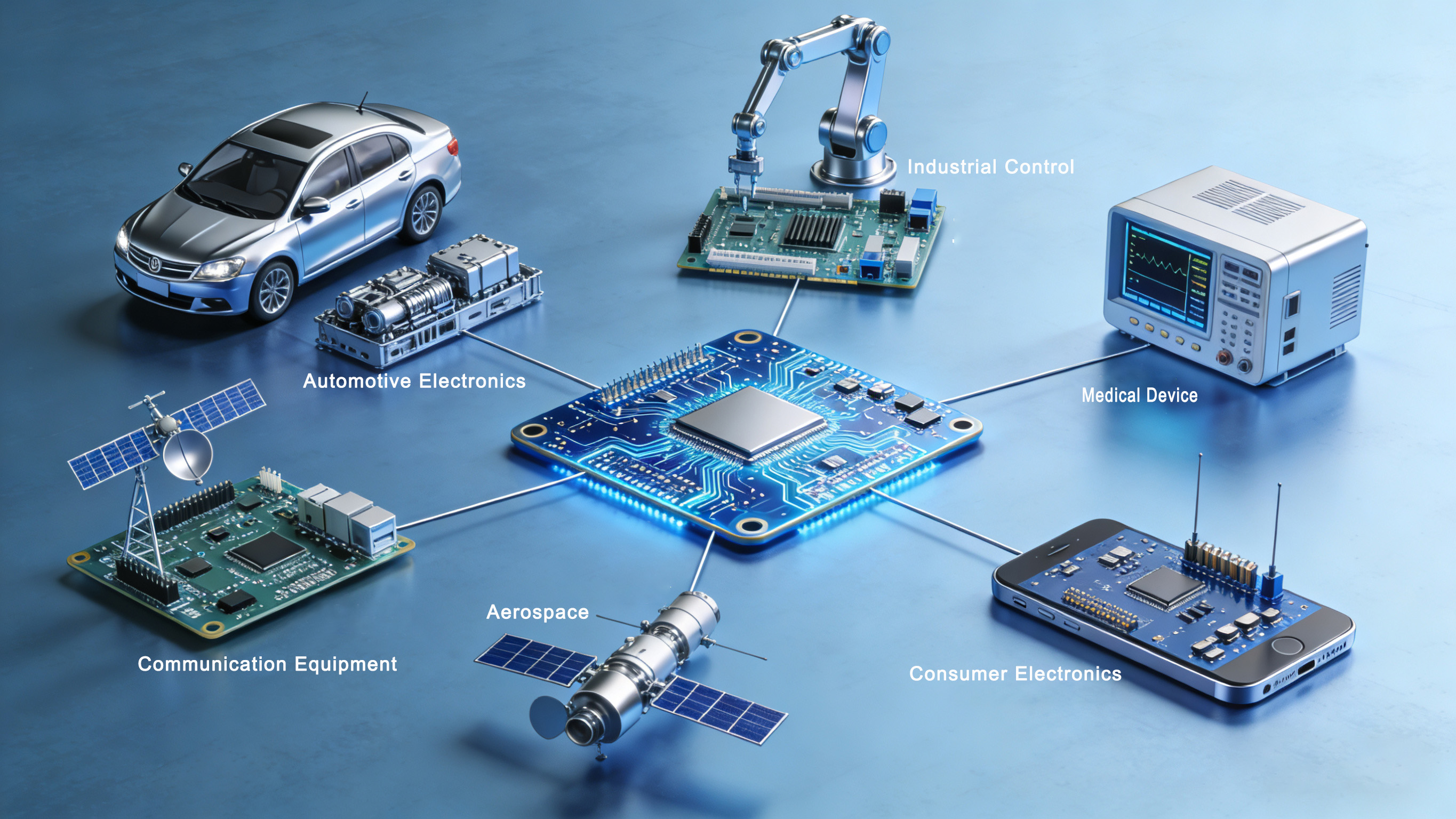
As the core carrier of electronic products, PCBA (Printed Circuit Board Assembly) has significantly diversified application characteristics due to differences in industry needs. From consumer electronics to industrial control, automotive manufacturing to medical devices, different industries have very different requirements for PCBA's performance, reliability, process, and environmental adaptability.
1. Consumer electronics industry: extreme compactness and rapid iteration
Consumer electronics such as smartphones, tablets, and wearables pursue thinness, compactness, functional integration, and cost control. These PCBA typically use high-density interconnect (HDI) technology, with multiple board layers, dense wiring, and extensive use of miniaturized packaged components (such as the 01005 specification). Thermal designs need to efficiently manage heat in a limited space while requiring high-speed signal integrity to support data streams such as 5G and high-definition video. The short product life cycle requires the PCBA supply chain to respond quickly, the design iteration is fast, and the cost is extremely sensitive, and standardized modules are often used to shorten the development cycle.
2. Automotive electronics industry: high reliability and environmental resistance
Automotive electronic PCBA need to work stably in harsh environments such as severe vibration, wide temperature range (-40°C to 125°C), high humidity and chemical corrosion. Its design core is ultra-high reliability and long life, usually following automotive-grade standards (e.g., AEC-Q100, IATF 16949), automotive-grade components and reinforcement processes (e.g., conformal paint coating, shock-resistant sockets). With the development of intelligent driving, PCBA related to ADAS (Advanced Driver Assistance Systems) also needs to process a large amount of sensor data, emphasize high-speed communication and low latency, and meet functional safety standards (ISO 26262). The supply chain focuses on long-term stability and traceability.
3. Industrial and Energy Sector: Resilience and Customization
PCBA for industrial control equipment (e.g., PLCs, robots) and energy systems (e.g., inverters, charging piles) need to adapt to factory grid fluctuations, electromagnetic interference, and continuous operating pressures. The design focuses on anti-interference capabilities, power handling, and long-term stability, often using thick copper plates, isolation circuits, and reinforced heat dissipation structures (such as metal substrates). The modularity and scalability of industrial PCBA are highly demanding to adapt to different equipment configurations. Due to the complexity of use scenarios, most of them are customized designs, and there are clear requirements for protection level (IP level) and adaptability to working conditions.
4. Medical Device Industry: Precision safety and compliance are prioritized
Medical electronic PCBA is directly related to life and health, and its core features are ultra-high precision, absolute safety and strict compliance. Whether it is an imaging device or a portable monitor, PCBA must meet medical electromagnetic compatibility (EMC) standards and ensure the ultimate accuracy of signal acquisition and processing. Materials need to be biocompatible and resistant to disinfection processes, designed with low noise, isolation protection, and fail-safe mechanisms. The production process must comply with medical quality management systems (e.g., ISO 13485) and complete rigorous certifications (e.g., FDA, CE), and any changes must be re-validated, resulting in long product cycles and much higher reliability requirements than general consumer-grade products.
5. Aerospace and Defense: Extreme reliability and technological frontiers
PCBA in this field is at the top of technology, pursuing absolute reliability in extreme environments, and needs to withstand conditions such as super vibration, cosmic radiation, and vacuum. Using aerospace-grade components and special materials (such as ceramic substrates), the process focuses on redundant design and derating use. PCBA for high-frequency communication and radar systems involves microwave radio frequency and high-frequency high-speed design, with extremely high precision requirements. Due to national security, the supply chain is independent and controllable, and it needs to meet strict standards such as DO-254, which is low cost sensitivity but extremely complex testing and verification processes.
6. Communication equipment industry: high-speed, high-frequency and continuous operation
PCBA for communication base stations and optical transmission equipment is characterized by high-speed signal processing and high-power radio frequency, which requires high-frequency millimeter wave signals to be processed, and has extremely high requirements for impedance control, loss, and heat dissipation. Designs often incorporate specialized RF sheets (such as Rogers materials) with a focus on power integrity and thermal management. The long-term reliability of PCBAs is critical as equipment requires 24×7 hours of uninterrupted operation, hundreds of thousands of hours of mean time between failures (MTBF), and high maintenance costs.
In summary, the application characteristics of PCBA have been deeply integrated into the essential needs of various industries: consumer electronics chase compactness and cost under Moore's Law, automotive electronics advocate safety and durability, medical equipment adheres to the precision of life first, industrial fields focus on adaptability and robustness, and aerospace challenges the limits of reliability. Understanding these differences is not only about technological realization, but also a key prerequisite for the success of electronic products in various fields.
Why green has become the main color of PCB production
Factors Determining the Cost of Flexible PCB


SEND MESSAGE